
Learn to remove tattoos with laser safely, honestly and to a professional standard. This course follows the Skintastic Laser Tattoo Removal Student Training Manual and Workbook and prepares you for your compulsory practical day with Carla in Southampton.
Accredited CPD course: 8 CPD credits
The CPD Group accredited activity #1004447. Skintastic Aesthetic Lasers Ltd is an approved CPD provider (#777800). This is a CPD course: it is not a regulated qualification and carries no qualification level.
Check this accreditation yourself on The CPD Register.
What this course covers
- UK regulations, laser safety, Local Rules and compliance, including the roles of the LPA, LPS and Authorised User
- Skin anatomy, how tattoo ink stays in place and how the laser and immune system clear it
- Wavelengths and ink colours, including difficult and dangerous pigments
- Consultation, Fitzpatrick skin typing, contra-indications, medication and the Kirby-Desai scale
- Patch testing, allergic reactions and anaphylaxis first aid
- Treatment technique, wavelength sequencing, full-circle and large tattoos
- Treating darker skin types (Fitzpatrick V to VI) safely
- Eye safety, aftercare, side effects, complications, case studies and records
How it works
The course carries 8 CPD credits. You study the theory online at your own pace, answering the quizzes and written questions online. Multiple choice is marked automatically, and your written answers are read with the help of an AI assistant, with feedback by email. You then attend one compulsory full practical day, face to face at 26 The Avenue, Southampton, which is included in the price and arranged by email after you buy. Skintastic provides the models, you will treat a minimum of three models, and Carla observes every treatment you carry out. A hardback manual and workbook is posted to you free of charge when you buy. Results vary between clients, and the course teaches honest expectations: complete removal can never be guaranteed. You will need a regulated Level 3 qualification in Anatomy and Physiology (or equivalent), a Laser and IPL Core of Knowledge certificate, and to be 18 or over.
Your certificate: Your certificate appears on your course page once you have completed the online theory. It becomes valid once Carla has observed you carry out every treatment on your practical day and confirms it.
Student support group
Studying with us? Join our student support group on Facebook for help, answers and updates from the academy. Join the student support group.
Course at a glance
| CPD credits | 8 |
|---|---|
| CPD Group activity number | #1004447 |
| Practical day | One compulsory full day, face to face in Southampton, included in the price; you will treat a minimum of three models |
| Lessons | 13 lessons, 74 topics |
| Certificate | Appears on the course page once the online theory is complete; valid once Carla has observed you and confirms it |
Who can take this course
Essential: a regulated Level 3 qualification in Anatomy and Physiology (or equivalent); Laser and IPL Core of Knowledge certificate; age 18 or over. Before you treat paying clients you will also need a certificated Laser Protection Adviser, Local Rules, a written risk assessment and insurance that names laser tattoo removal.
What you will learn
- Explain how Class 3B and Class 4 lasers and IPL are regulated in England, Wales, Scotland and Northern Ireland
- Describe what the CQC position means for cosmetic laser work
- Name the three layers of the skin and describe what each does
- Explain where tattoo ink is deposited
- Explain what a wavelength is and why ink must absorb it
- Describe the characteristics of 1064nm and 532nm
- Explain why a robust, compliant consultation is the foundation of safe treatment
- Describe the suggested new-client protocol from waiting room to consent
- Explain why patch testing is a clinical and legal necessity
- State the benefits of a test patch for you and the client
- List the instructions you give a client before their appointment
- Explain the reason for each instruction
- Explain the role of melanin in laser absorption
- List the unintended effects of epidermal melanin absorption
- Explain why eye protection is the most important control
- State the requirements for client eyewear
- Explain why case-study reflection matters
- Use a simple structure to analyse a poor outcome
- List the five forms in each model set
- Explain what each form is for
Course structure
Lesson 1: Start here: your course guide (5 topics)
- Welcome to your Laser Tattoo Removal course
- What the course covers and what it does not
- Your course structure, practical day and delivery
- How you are assessed
- Your course leader, your responsibilities and accessibility
Lesson 2: UK regulations, laser safety and compliance (9 topics)
- How lasers are regulated across the UK
- Local authority licensing and the proposed national scheme
- The Laser Protection Adviser and the minimum safety requirements
- Qualification levels and your treatment protocol
- The three safety roles and your Local Rules
- The controlled area and room safety
- The laser use register, hygiene and the LPA site visit
- Health and safety law and the device itself
- Records, data protection, advertising and your compliance checklist
Lesson 3: Skin anatomy and how tattoos stay in place (5 topics)
- The structure of the skin and where ink sits
- How tattoos stay in place
- How the laser and the immune system remove ink
- Why removal takes many sessions, and why we wait between them
- Needle depth and why no two tattoos are the same
Lesson 4: How laser removal works: wavelengths and ink colours (6 topics)
- Wavelengths: the basics, 1064nm and 532nm
- Knowing your handpieces and the colour guide
- Difficult and resistant inks
- White and pale pigments: the blackening risk
- Green and yellow: the hardest colours
- Client communication about colour and clearance
Lesson 5: Consultation, suitability and contra-indications (9 topics)
- Why the consultation matters
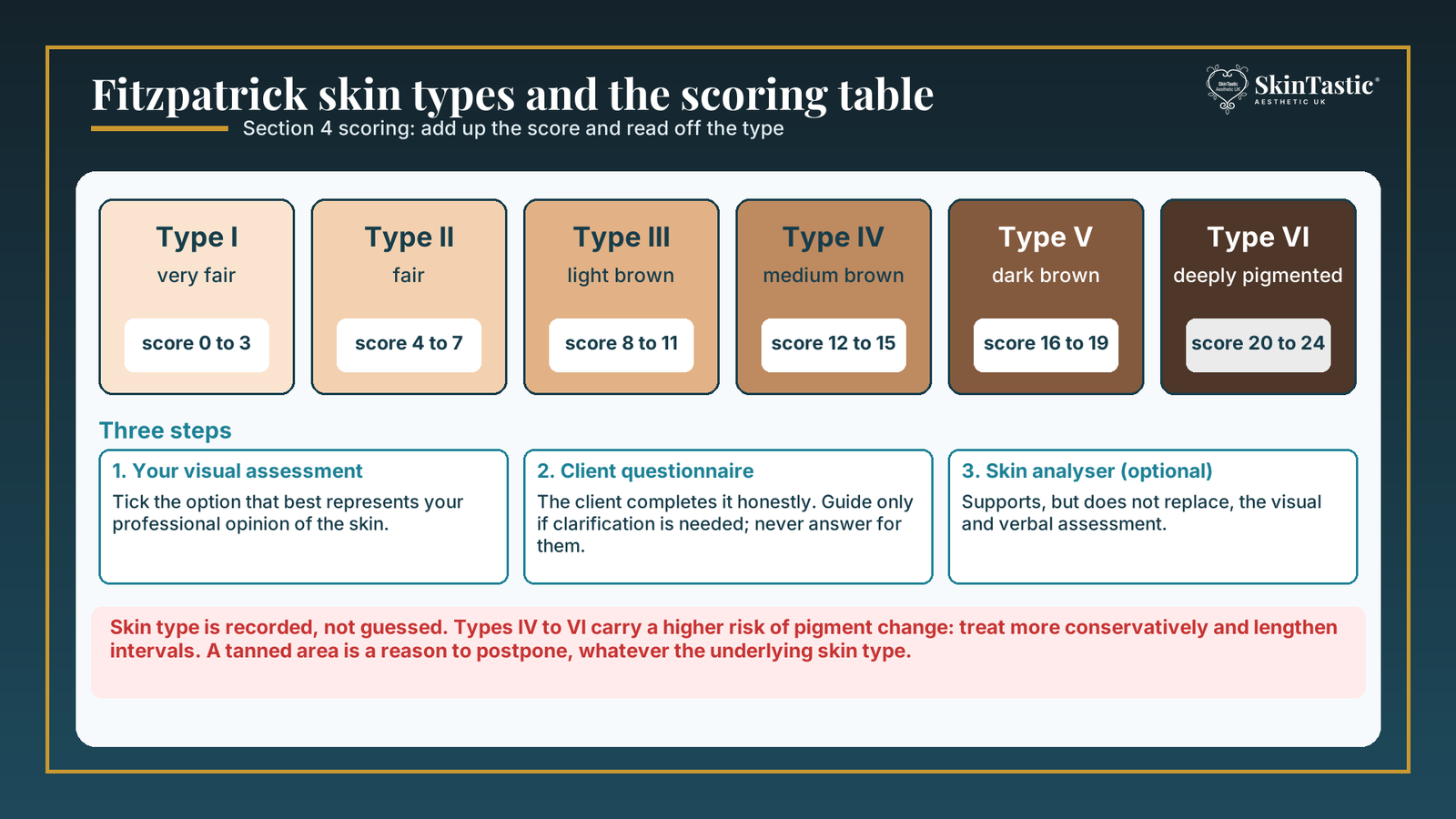
- Fitzpatrick skin typing
- Recent tanning and UV exposure
- Absolute exclusions: immune system, liver and bleeding conditions
- Absolute exclusions: skin, cancer treatment and other conditions
- Right-hand column conditions, moles and lesions
- The medication advisory protocol
- Estimating sessions with the Kirby-Desai scale
- Factors that influence removal and the density worksheet
Lesson 6: Patch testing and allergic reactions (7 topics)
- Why patch testing is critical
- Wheal and flare: recognising an immediate hypersensitivity reaction
- Anaphylaxis: recognition and first-aid response
- Adrenaline auto-injectors: using an EpiPen and the legal position
- A complete patch-test assessment
- Performing the patch test, step by step
- Documenting the patch test and practising placement
Lesson 7: The full treatment: protocol and technique (7 topics)
- Preparing the client before the first appointment
- Topical numbing creams: use with care
- In the room: safety before you fire
- Laser handling technique: controlling your delivery
- Wavelength sequencing for multi-coloured tattoos
- Reading the skin: observations and actions
- Treating full-circle tattoos and large tattoos
Lesson 8: Treating darker skin types safely (Fitzpatrick V to VI) (4 topics)
- The role of melanin and why darker skin needs special care
- Key risks when treating Fitzpatrick V to VI
- Safe-practice principles for Fitzpatrick V to VI
- Communicating risk and your legal and ethical responsibility
Lesson 9: Eye safety, aftercare, side effects and complications (6 topics)
- Eye safety: the single most important control
- Practitioner eyewear, gloves and full PPE
- Aftercare advice for clients
- What is normal, and what is not
- Side effects and complications, and how to respond
- Aftercare sheet and recording what you gave
Lesson 10: What went wrong? Case-study reflections and practitioner questions (4 topics)
- Learning from real cases: how to reflect
- Cases 1 and 2: blistering on red ink and on green ink
- Cases 3, 4 and 5: darker skin reaction, hand tattoo and limb over-treatment
- Questions practitioners often ask
Lesson 11: Forms, consent and record keeping (4 topics)
- The client forms pack
- The information and consent form: what the client is told
- Declarations and the model agreement
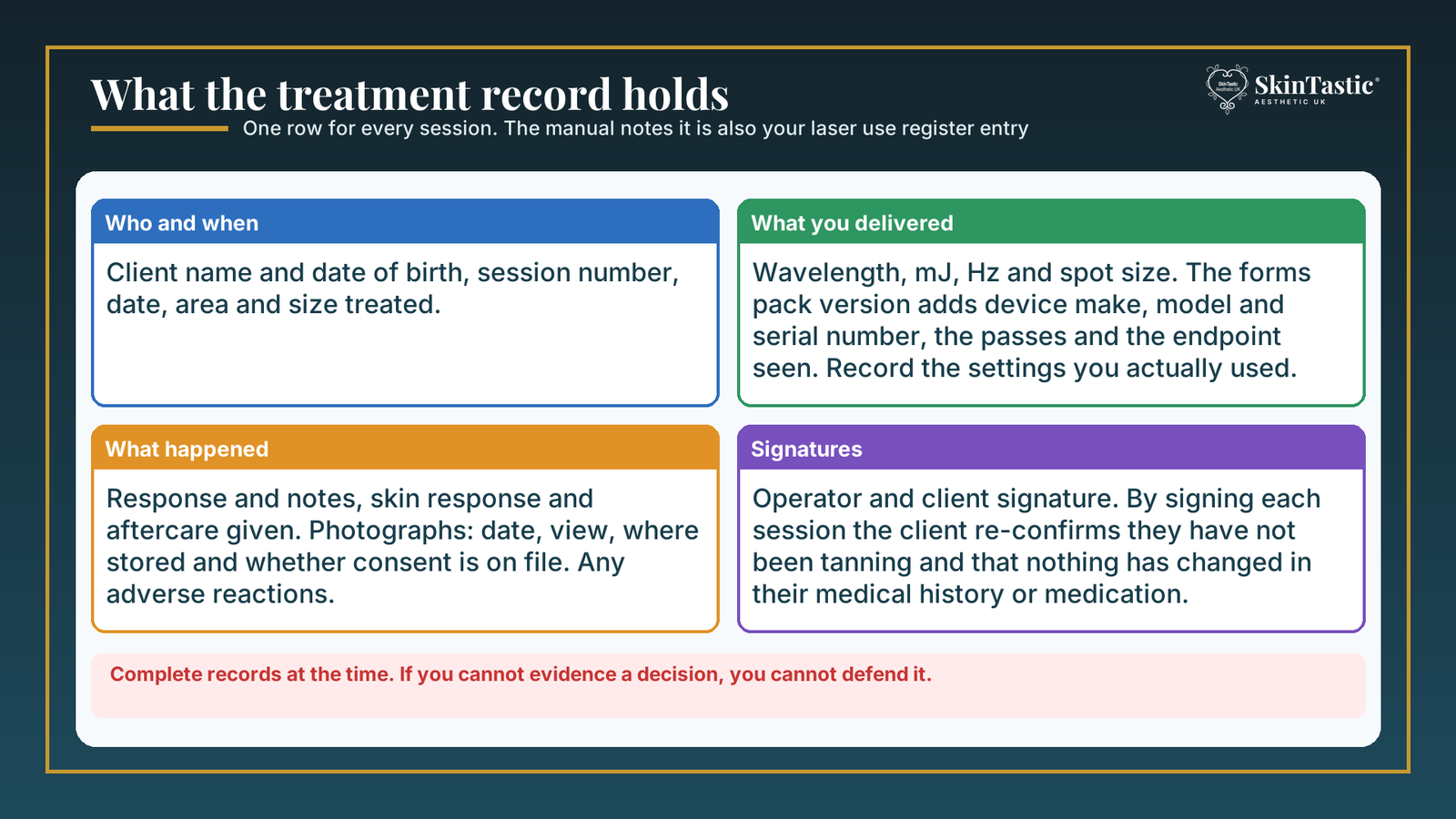
- Patch test records, treatment records and the laser register
Lesson 12: Your final assessment (3 topics)
- How your final assessment works
- Revision guide: the safety-critical points
- Written answers and scenarios: how to answer well
Lesson 13: Your practical day (4 topics)
- Your practical day programme
- What Carla observes, item by item
- Practical exercises on the day
- Your certificate and next steps
How you are assessed
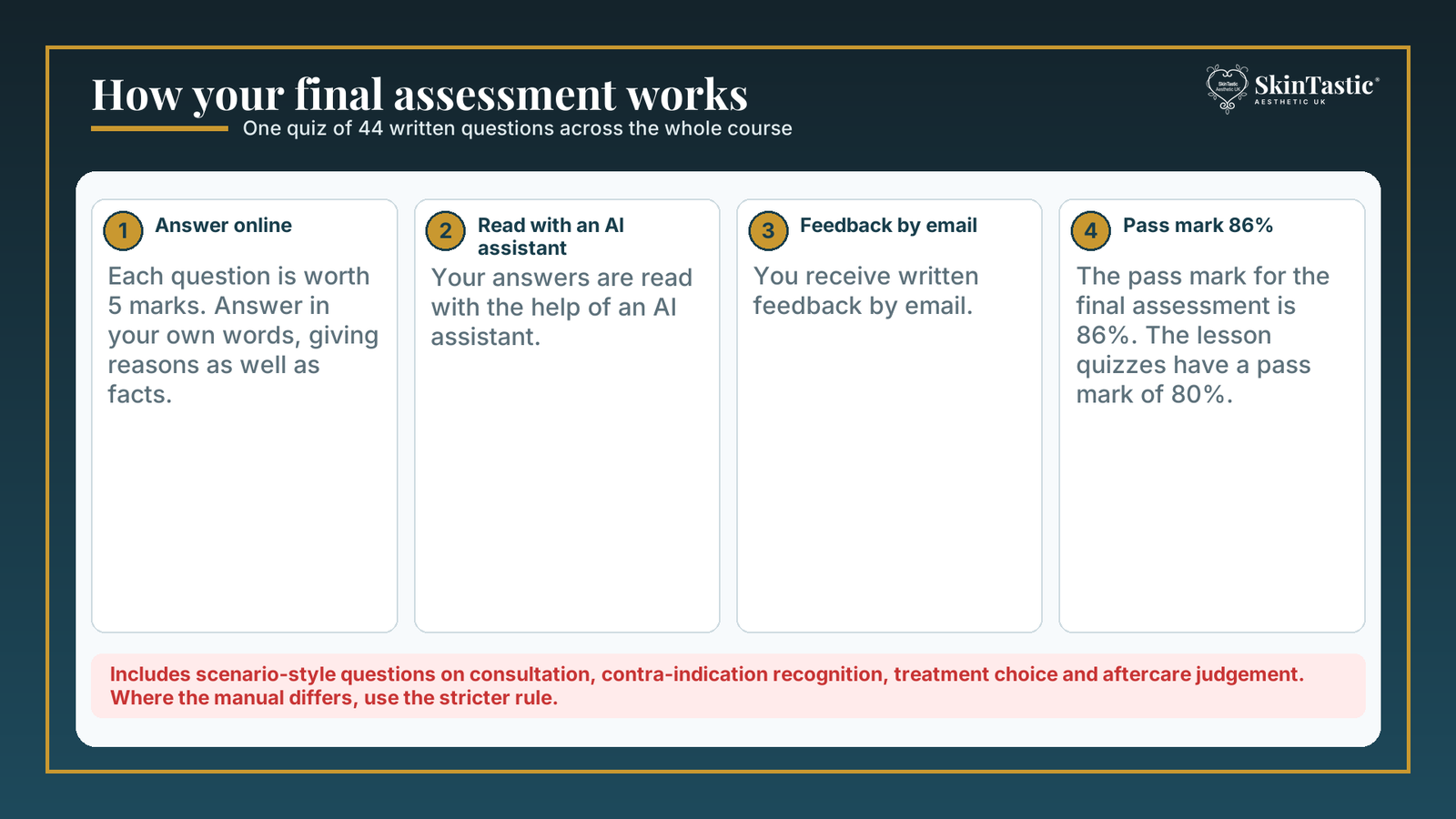
Each teaching lesson ends with a short multiple choice quiz, which is marked automatically. Your final assessment has two parts: Part A is 24 multiple choice questions, marked automatically, with a pass mark of 80%, and Part B is 44 written questions, answered online and read with the help of an AI assistant with feedback by email. On your practical day Carla observes you carry out every treatment. Your certificate appears on your course page once you have completed the online theory. It becomes valid once Carla has observed you carry out every treatment on your practical day and confirms it.
A look inside the course
3 of the diagrams and pictures from the online lessons.
Frequently asked questions
Do I have to attend a practical day?
Yes. One full practical day at our Southampton academy is part of the course and is included in the price, because laser treatment of live skin is learned face to face and cannot be done online. You will treat a minimum of three live models on the day, provided by Skintastic. We arrange it with you by email after you buy. Your certificate appears on your course page once you have completed the online theory. It becomes valid once Carla has observed you carry out every treatment on your practical day and confirms it.
How much does the Laser Tattoo Removal course cost?
The course costs £599. You can pay by card, Apple Pay, Google Pay or PayPal. Klarna and Clearpay may also be offered at checkout, subject to status.
Can I study at my own pace?
Yes. The online lessons let you work at your own pace and go over anything as many times as you need before your practical day. Your written work is completed online and read with the help of an AI assistant, with feedback by email.
What qualifications do I need before I buy?
Our course page asks for a regulated Level 3 qualification in Anatomy and Physiology (or equivalent) and a Laser and IPL Core of Knowledge certificate. If you are missing either, you can take them with us first. You must be 18 or over. We accept Recognition of Prior Learning against the Anatomy and Physiology requirement, so send us your evidence before you buy. If you hold other qualifications or experience, send them to us and we will tell you what we can accept.
Is the course accredited, and how do I check?
Yes. It is accredited by The CPD Group for 8 CPD credits (activity 1004447), and Skintastic Aesthetic Lasers Ltd is an approved provider, number 777800. You can verify it yourself on The CPD Register using the link on this page. It is a CPD course, not an Ofqual regulated qualification.
Will I get a certificate, and when?
You receive an accredited CPD certificate, 8 credits. Your certificate appears on your course page once you have completed the online theory. It becomes valid once Carla has observed you carry out every treatment on your practical day and confirms it. You also receive a CPD reflective record for your portfolio.
Will my insurer cover me?
We cannot promise that. Most insurers want to see an existing beauty or aesthetics qualification alongside a CPD certificate before they cover tattoo removal. Check with your insurer before you buy, or message us on WhatsApp and we will go through it with you.
Who provides the models, and does the course cover darker skin?
Skintastic provides the models, a minimum of three, with Fitzpatrick skin types I to IV. The course also has a full section on treating Fitzpatrick V and VI safely.
Will I receive a printed manual?
Yes. A hardback manual and workbook is posted to every student free of charge, as your study text. We post it to the address you enter at checkout.
How long do I have access to the online lessons?
Your access to the online lessons lasts 12 months from the date of purchase.
Can I cancel and get a refund?
You have 14 days to cancel, but the right to cancel the online materials is lost once your access starts and you have ticked the box at checkout to agree to that. Once the 14 days have ended, courses are non refundable. Refunds that apply are paid to the original payment method within 14 days of us receiving your written cancellation. Full details are in our terms and conditions.
More answers are on our frequently asked questions page, and our delivery page explains how your free hardback manual is posted.