
Learn to recognise what is yours to treat, and what is not, before you ever fire a machine. This course teaches the vascular use of intense pulsed light (IPL) and the 980 nm diode laser for thread veins, redness and vascular lesions, with equal weight on safety, honest consultation and knowing when to refer. It prepares you for your compulsory practical day.
Accredited CPD course: 8 CPD credits
The CPD Group accredited activity #1021413. Skintastic Aesthetic Lasers Ltd is an approved CPD provider (#777800). This is a CPD course: it is not a regulated qualification and carries no qualification level.
Check this accreditation yourself on The CPD Register.
What this course covers
- The blood supply of the skin and why vessels become visible
- Recognising vascular lesions, including the red flags and the lesions you must refer
- How light and laser energy treat a vessel, and the limits of IPL
- Consultation, contraindications, medication, skin typing, patch testing and consent
- IPL settings, technique and endpoints, and the 980 nm diode laser with its Class 4 safety rules
- Aftercare, complications, the published evidence, the law and your client records
How it works
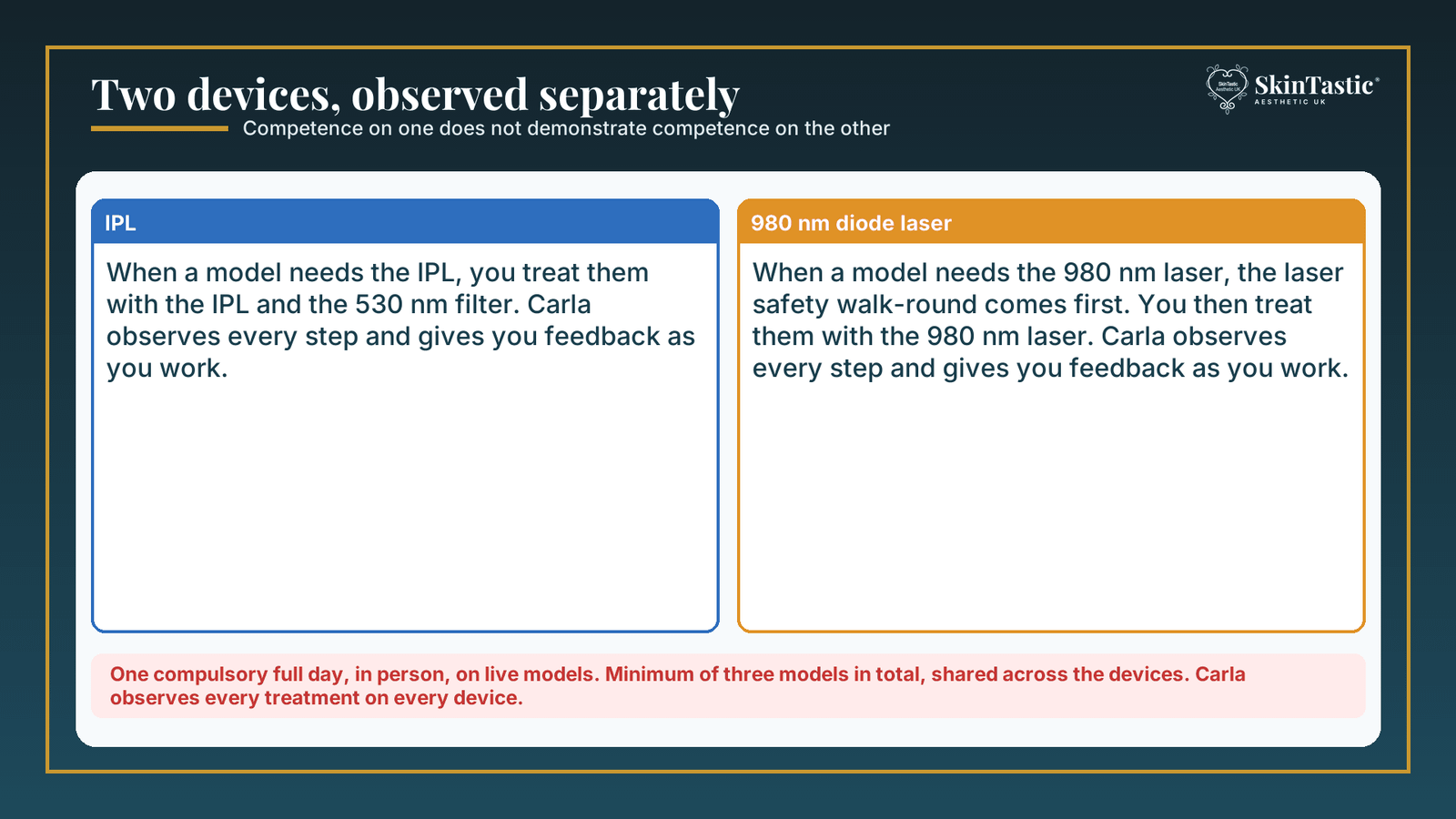
The course carries 8 CPD credits. You study the theory online at your own pace, answering the quizzes and written questions online. Multiple choice is marked automatically, and your written answers are read with the help of an AI assistant, with feedback by email. You then attend one compulsory full practical day, face to face at 26 The Avenue, Southampton, which is included in the price and arranged by email after you buy. Skintastic provides the models, you will treat a minimum of three models in total, shared across the devices, and Carla observes every treatment you carry out. A hardback manual and workbook is posted to you free of charge when you buy. Core of Knowledge, device-specific training and insurance naming vascular treatment are needed before you treat paying clients. Entry requirements are listed under Who can take this course below.
Your certificate: Your certificate appears on your course page once you have completed the online theory. It becomes valid once Carla has observed you carry out every treatment on your practical day and confirms it.
Student support group
Studying with us? Join our student support group on Facebook for help, answers and updates from the academy. Join the student support group.
Course at a glance
| CPD credits | 8 |
|---|---|
| CPD Group activity number | #1021413 |
| Practical day | One compulsory full day, face to face in Southampton, included in the price; you will treat a minimum of three models in total, shared across the devices |
| Lessons | 14 lessons, 102 topics |
| Certificate | Appears on the course page once the online theory is complete; valid once Carla has observed you and confirms it |
Who can take this course
Essential: Core of Knowledge in the safe use of lasers and intense light sources; Level 3 Anatomy and Physiology or an equivalent recognised qualification; aged 18 or over. Essential before you treat: device-specific training on the IPL and the 980 nm diode laser you will use, and public liability and professional indemnity insurance covering vascular treatment. Desirable: previous IPL or laser experience. Recognition of Prior Learning is accepted for the essential requirements. Every learner completes the compulsory practical day.
What you will learn
- Name arteries, veins and capillaries and describe how each is built
- Explain which vessel type you are aiming at in vascular treatment
- State the rule that underpins lesion recognition
- Describe the four steps used to work out what a lesion is
- Explain what intense pulsed light is
- Compare an IPL with a laser
- Describe the stages of a vascular consultation
- Explain why the consultation and first treatment are separate visits
- List the five areas you check before every treatment
- Prepare the room and the machine safely
- Carry out the test pulse sequence
- Interpret the three possible outcomes of a test pulse
- Explain how a 980 nm diode laser treats a vessel
- State why the 980 nm laser must be learned as a separate machine
- Give correct aftercare advice
- Explain the reason behind each piece of advice
- Follow a complete client journey from first enquiry to consultation findings
- Explain how each consultation finding changed the plan
- Name the main bodies that regulate laser and IPL practice
- State what each body covers
- List the client forms and what each is used for
- Follow the correct order of paperwork for a new client
Course structure
Lesson 1: Start here: your course guide (6 topics)
- Welcome: what this course is really teaching you
- Your course at a glance
- What this course covers, and what it does not
- Course learning outcomes
- Entry requirements and Recognition of Prior Learning
- How the course is delivered, and support for you
Lesson 2: The blood supply of the skin (7 topics)
- The three types of blood vessel
- The circulation and what gives blood its colour
- Haemoglobin is your target, not the vessel
- Red vessels and blue vessels
- Where the vessels sit in the skin
- Why a vessel becomes permanently visible
- Leg veins: why the pressure matters
Lesson 3: Recognising vascular lesions (9 topics)
- If you cannot name it, you do not treat it
- Blanching, refill and the glass slide
- Treatable lesions: thread veins and rosacea
- Treatable lesions: spider naevi and cherry angiomas
- Treatable lesions: poikiloderma and diffuse redness
- The truth about legs
- NICE criteria: when a leg vein client goes to a doctor
- Lesions you refer
- The red flags: stop, and send them to a doctor
Lesson 4: How light and laser energy treat a blood vessel (9 topics)
- What an IPL is, and how it differs from a laser
- Absorption: haemoglobin, melanin and wavelength
- Selective photothermolysis
- Thermal relaxation time and vessel size
- Choosing a cut-off filter
- Wavelength, depth and pulse structure
- The controls and how to adjust them safely
- What happens in the skin, step by step
- Being honest about the limitations of IPL
Lesson 5: Consultation, contraindications and patch testing (11 topics)
- The vascular consultation
- Photographs, records and the plan
- Absolute contraindications
- Pregnancy, breastfeeding and trying to conceive
- Relative contraindications
- Medication and photosensitising agents
- Skin typing and the Fitzpatrick scale
- A tan is a skin type change
- Carrying out a patch test
- Waiting times, reading and repeating the patch test
- Informed consent and realistic expectations
Lesson 6: The treatment: preparation and choosing settings (7 topics)
- Before the client comes in
- Eye protection and preparing the client
- Choosing your parameters: reasoning and published ranges
- Which way each control moves
- Your IPL: the 530 nm filter and the two working modes
- Manufacturer's starting parameters: N mode, 530 nm
- Manufacturer's starting parameters: S mode and the adjustment rule
Lesson 7: The treatment: technique, endpoints and finishing (7 topics)
- The test pulse sequence and entering your settings
- IPL technique on the face
- IPL technique on legs, neck, chest and body
- Endpoints: what you are looking for
- Stop immediately: the warning signs
- Immediately afterwards
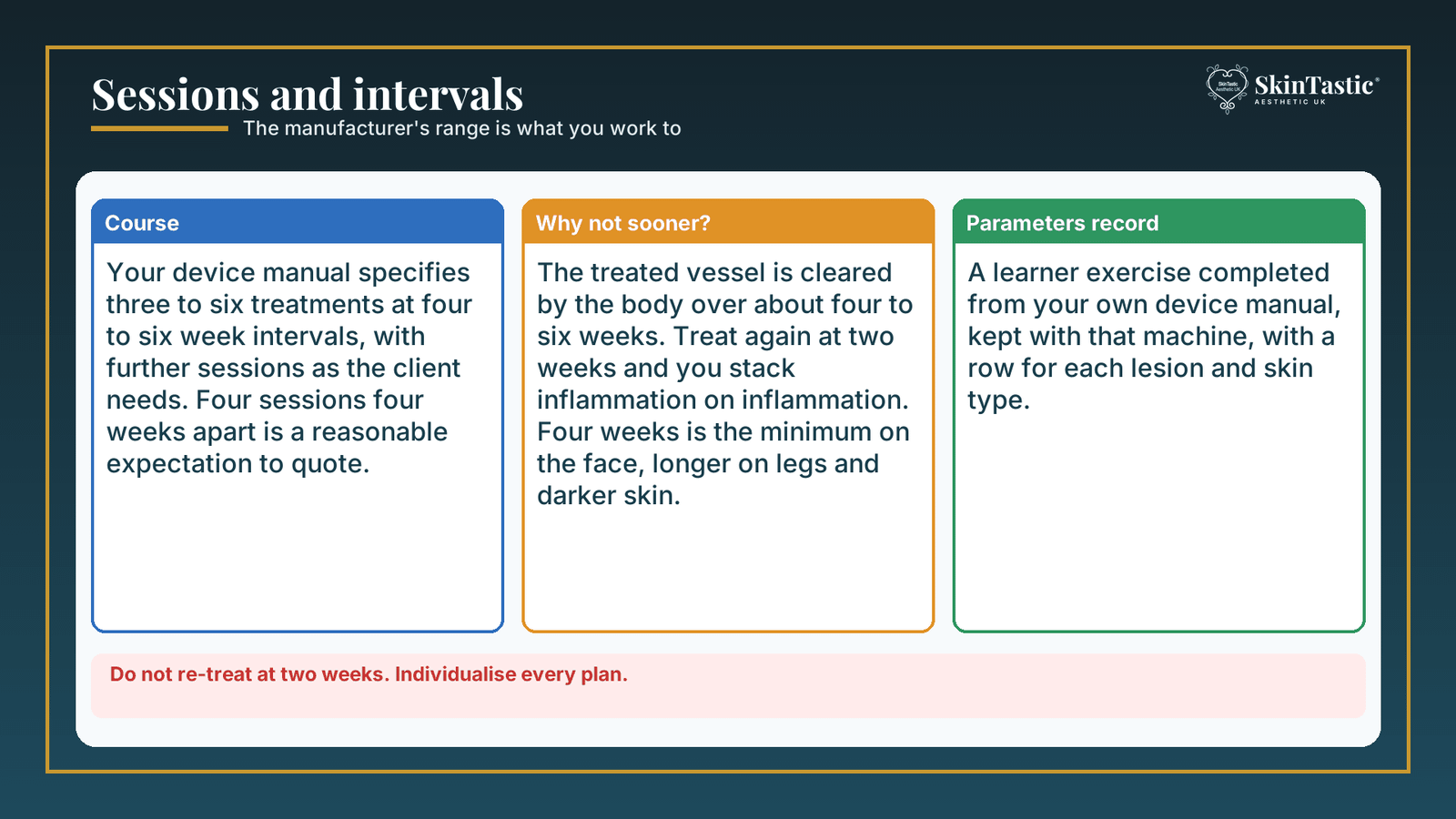
- Sessions, intervals and your parameters record
Lesson 8: The 980 nm diode laser: treating one vessel at a time (9 topics)
- The 980 nm diode is not an IPL
- The two technologies side by side
- Class 4 laser safety: an invisible beam
- What Class 4 means in your treatment room
- Your handpiece, the fibre and the focus rings
- Power and pulse width
- 980 nm technique and endpoint
- Aftercare after 980 nm treatment
- Choosing between the two machines
Lesson 9: Complications, aftercare and managing results (7 topics)
- Aftercare: what to say and why
- Expected reactions and how the area heals
- When something goes wrong: your first actions
- Complications in detail: skin reactions
- Complications in detail: other complications
- Who you report to, and when
- When a client is unhappy
Lesson 10: A worked client case and the guidance behind the course (5 topics)
- Mrs H: presentation and consultation
- Mrs H: expectations and the treatment course
- What the case teaches
- The evidence behind this treatment
- Finding and using the guidance
Lesson 11: Legislation and regulatory requirements (9 topics)
- Who regulates what
- Health and safety: the optical radiation regulations
- The rest of the health and safety picture
- The device itself: medical device rules and incident reporting
- Cosmetic devices, the machines on this course, and buying second hand
- Licensing in England
- Scotland, Wales and Northern Ireland
- Laser Protection Adviser, Expert Medical Practitioner and your clients' rights
- Your compliance checklist and where to check
Lesson 12: Your client forms, model sets and course completion (6 topics)
- Your client forms and the order of the paperwork
- The skin typing form and the medical history form
- Lesion assessment and the consent forms
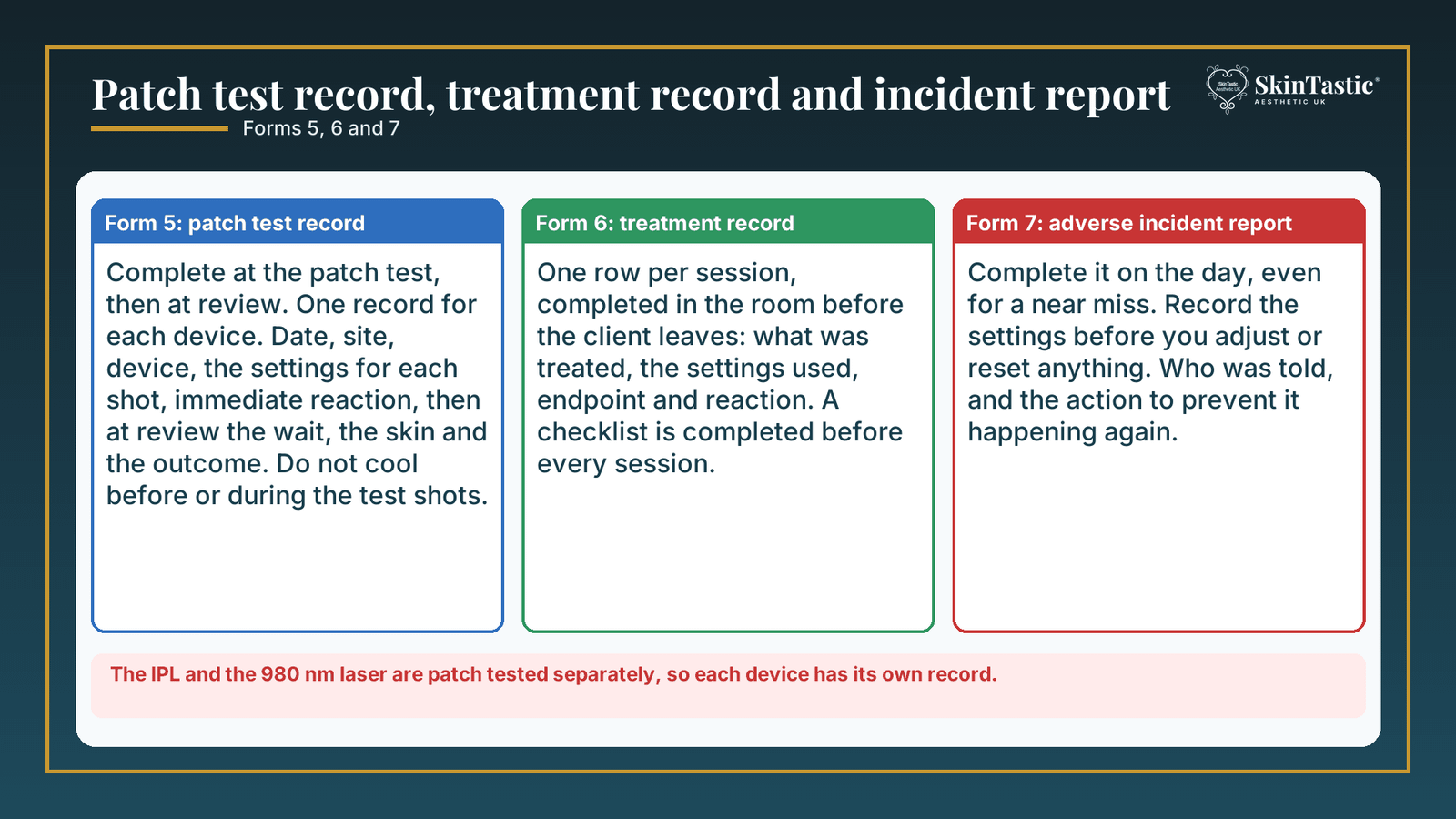
- Patch test, treatment record and incident report
- Aftercare sheets and using both devices on one client
- Model sets and course completion
Lesson 13: Your final assessment (4 topics)
- How the written assessment works
- Part A: how to approach the multiple choice questions
- Parts B and C: writing good answers
- Revision map: where each outcome is taught
Lesson 14: Your practical day (5 topics)
- How your practical day works
- Models and preparing for your practical day
- Your IPL treatment: what Carla observes
- Your 980 nm laser treatment: what Carla observes
- Your certificate and next steps
How you are assessed
Each teaching lesson ends with a short multiple choice quiz, marked automatically (pass mark 80%). The final assessment has three parts. Part A is 27 multiple choice questions, marked automatically (pass mark 80%). Part B is ten written questions and Part C is three client scenarios, answered online and read with the help of an AI assistant, with feedback by email (pass mark 80% for each). Your practical skills are observed on your compulsory practical day: Carla observes every treatment you carry out and gives feedback as you work. Your certificate appears on your course page once you have completed the online theory, and it becomes valid once Carla has observed every treatment on your practical day and confirms it.
A look inside the course
3 of the diagrams and pictures from the online lessons.
Frequently asked questions
Do I have to attend a practical day?
Yes. One full practical day at our Southampton academy is part of the course and is included in the price, because treatment of live skin is learned face to face and cannot be done online. You will treat a minimum of three models in total, shared across the IPL and the 980 nm diode laser, provided by Skintastic. We arrange it with you by email after you buy. Your certificate appears on your course page once you have completed the online theory. It becomes valid once Carla has observed you carry out every treatment on your practical day and confirms it.
How much does the course cost?
The course costs £399. Pay by card, Apple Pay, Google Pay or PayPal. Klarna and Clearpay may also be offered at checkout, subject to status.
Can I study at my own pace?
Yes. The online lessons let you work at your own pace and go over anything as many times as you need before your practical day. Your written work is completed online and read with the help of an AI assistant, with feedback by email. The practical day is a fixed date that we arrange with you by email after you buy.
What qualifications do I need first?
You need the Laser and IPL Core of Knowledge certificate, a regulated Level 3 qualification in Anatomy and Physiology or equivalent, and to be 18 or over. If you are missing the Core of Knowledge or Level 3 Anatomy and Physiology, you can take them with us first. We accept Recognition of Prior Learning against the entry requirements if you send us your evidence before you buy. It is never accepted in place of the practical day.
Is the course accredited, and how do I check?
Yes. It is accredited by The CPD Group as activity #1021413 for 8 CPD credits, and anyone can check it on The CPD Register using the link in the accreditation section above. It is CPD, not a regulated qualification, so it carries no qualification level.
Will I get a certificate, and when?
Yes. Your certificate appears on your course page once you have completed the online theory. It becomes valid once Carla has observed you carry out every treatment on your practical day and confirms it. It shows 8 CPD credits, and you also receive a CPD reflective record for your portfolio.
Will my insurer cover me?
We cannot promise that. Most insurers want to see an existing beauty or aesthetics qualification alongside a CPD certificate, and your policy must name vascular treatment. Check with your insurer before you buy, or message us and we will help you check.
Who provides the models, and what should I wear?
Skintastic provides the models, a minimum of three in total across the two devices, and lunch is provided. Please wear salon clothes or smart casual, because the training is clinical.
Will I receive a printed manual?
Yes. A hardback manual and workbook is posted to every student free of charge, as your study text, including outside the UK. We post it to the address you enter at checkout.
How long do I have access to the online lessons?
Your access to the online lessons lasts 12 months from the date of purchase.
Can I cancel and get a refund?
You have 14 days to cancel, but the right to cancel the online materials is lost once your access starts and you have ticked the box at checkout to agree to that. Once the 14 days have ended, courses are non refundable. Refunds that apply are paid to the original payment method within 14 days of us receiving your written cancellation. Full details are in our terms and conditions.
More answers are on our frequently asked questions page, and our delivery page explains how your free hardback manual is posted.