
Learn to use radio frequency for skin tightening safely, honestly and with confidence. This course teaches the science, safety, consultation, settings, technique and aftercare of radio frequency (RF) skin tightening, practised on the tripolar RF handpiece of the DPL4. It prepares you for your compulsory practical day with Carla in Southampton.
Accredited CPD course
This is a CPD course from Skintastic Aesthetic Lasers Ltd, an approved CPD provider (#777800). CPD accreditation for this course has been applied for, so no CPD credits or activity number are shown yet. This is a CPD course: it is not a regulated qualification and carries no qualification level.
What this course covers
- What RF is, how it heats the skin, and what it can and cannot do
- The skin, collagen, ageing and skin types
- The DPL4 tripolar RF handpiece: controls, screen, start-up, cleaning and troubleshooting
- Electrical safety, burn prevention, hygiene and infection control
- Consultation, contraindications, consent, photographs and the test patch
- Settings, the tolerance test and safe endpoints
- Eight step-by-step treatment protocols for face, neck and body
- Sessions, the clinical evidence, aftercare, side effects and burns first aid
- UK law, insurance, advertising and records
How it works
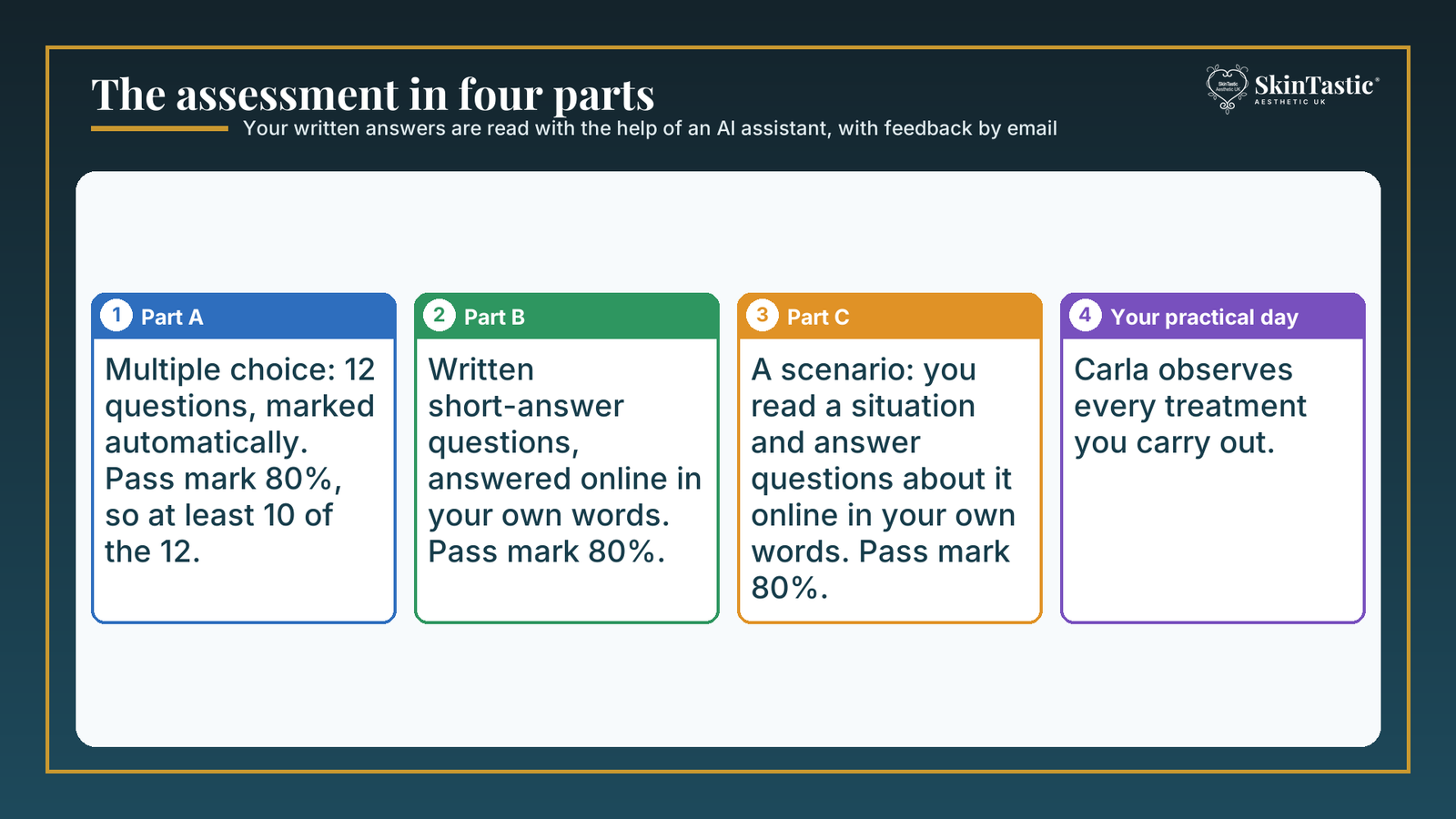
You study the theory online at your own pace, answering the quizzes and written questions online. Multiple choice is marked automatically, and your written answers are read with the help of an AI assistant, with feedback by email. You then attend one compulsory full practical day, face to face at 26 The Avenue, Southampton, which is included in the price and arranged by email after you buy. Skintastic provides the models, you will treat a minimum of three models, and Carla observes every treatment you carry out. A hardback manual and workbook is posted to you free of charge when you buy. Entry requirements are a recognised anatomy and physiology qualification (Level 3 or above) and appropriate insurance.
Your certificate: Your certificate appears on your course page once you have completed the online theory. It becomes valid once Carla has observed every treatment you carry out on your practical day and confirms it.
Student support group
Studying with us? Join our student support group on Facebook for help, answers and updates from the academy. Join the student support group.
Course at a glance
| Practical day | One compulsory full day, face to face in Southampton, included in the price; you will treat a minimum of three models |
|---|---|
| Lessons | 14 lessons, 87 topics |
| Certificate | Appears on the course page once the online theory is complete; valid once Carla has observed you and confirms it |
Who can take this course
A recognised qualification in anatomy and physiology (Level 3 or above), and appropriate insurance. Recognition of Prior Learning may be accepted for the entry requirements. Every student attends the practical day.
What you will learn
- Explain in plain English what radio frequency (RF) is
- State three things RF is not
- Explain in plain words how RF current makes heat in the skin
- State the heat rule and what it means in practice
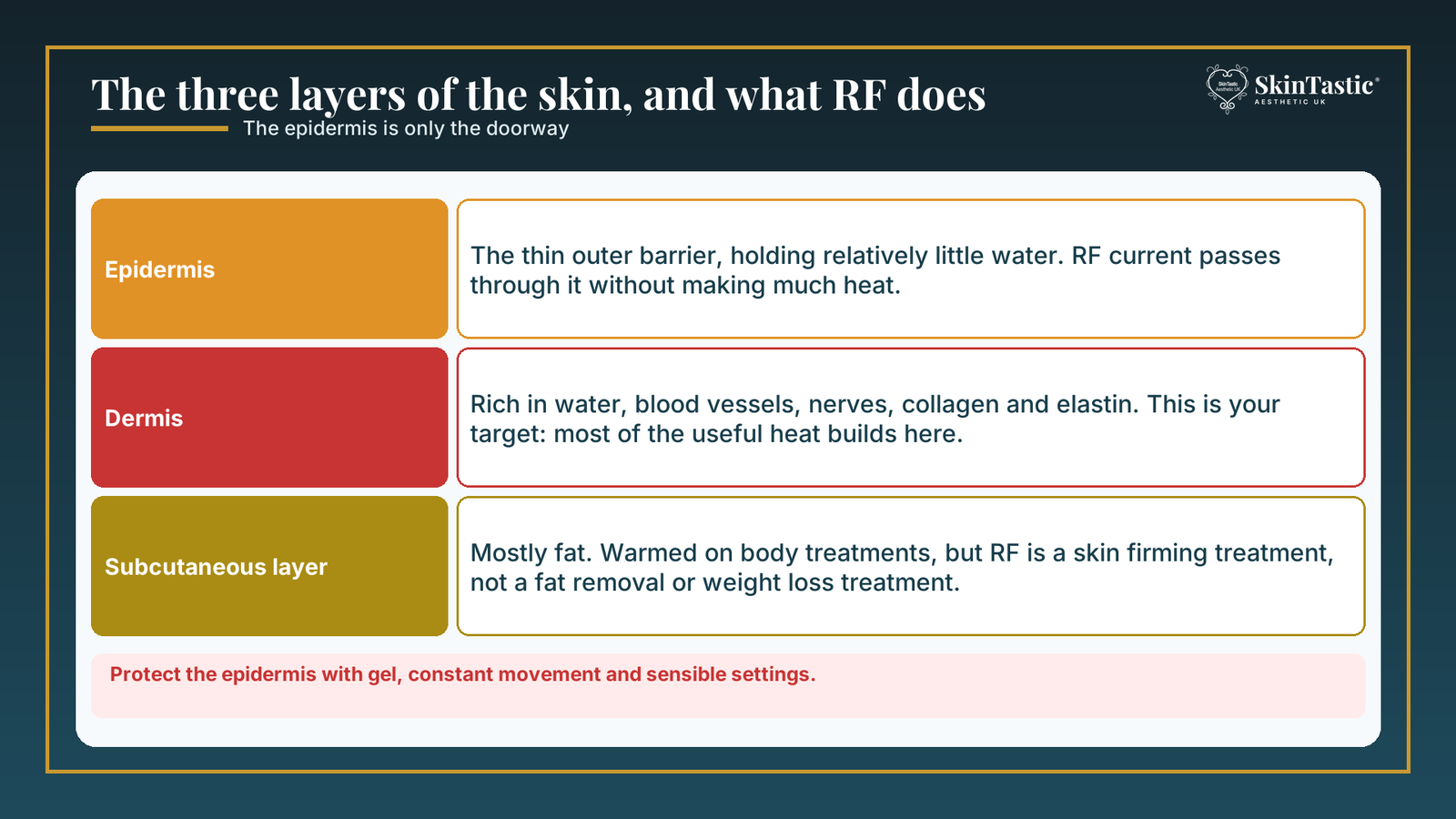
- Name the three layers of the skin and explain what RF does in each
- Explain why the dermis is the target of treatment
- Describe what kind of machine the DPL4 is and which part you use
- Find the emergency stop, key switch, main power switch and foot switch socket
- Carry out the five electrical safety checks before each session
- Explain why extension leads and adaptors must not be used
- Explain why the consultation is the most important safety step
- List the four parts of the consultation
- Explain what power, pulse duration and pulse interval each do
- State what happens when each dial is turned up or down
- Prepare the room, machine and paperwork before the client lies down
- Prepare the client and the skin correctly
- Describe a typical course of RF for the face and the body
- Explain why the guidance is a starting point rather than a rule
- List the normal reactions after RF and how long they last
- Apply the simple test that separates normal reactions from warning signs
- Name the main bodies that regulate RF practice and what each covers
- Summarise licensing in England, Scotland, Wales and Northern Ireland
Course structure
Lesson 1: Start here: your course guide (5 topics)
- Welcome to your training
- Your course at a glance
- What you will be able to do: the course learning outcomes
- How you are assessed and how you complete the course
- Your course leader, your responsibilities and learning support
Lesson 2: What radio frequency is and what it does (4 topics)
- What radio frequency is, and what it is not
- What RF may help with, and what it cannot do
- RF compared with laser and IPL, and the honest advantages and limits
- Meet your teaching device in outline
Lesson 3: How RF works on the skin, and why (5 topics)
- How radio frequency makes heat
- The tripolar head and how deep it heats
- Why gel and constant movement are essential
- The temperature window, and why time matters
- Heat, collagen and fat, and the language of RF settings
Lesson 4: The skin, collagen, ageing and skin types (5 topics)
- The three layers of the skin, and what RF does in each
- Collagen, elastin and healing: why results take time
- Ageing, laxity and the pinch test
- Lesions you must recognise and refer
- Fitzpatrick skin types and RF
Lesson 5: Your teaching device: the DPL4 tripolar RF handpiece (8 topics)
- The DPL4 at a glance and the controls you must know
- Handpieces stay connected, and the Laser Controlled Area
- The tripolar RF handpiece and the foot pedal
- Switching on and choosing RF
- The RF screen: what each item means
- Treating order, saving client settings and shutting down
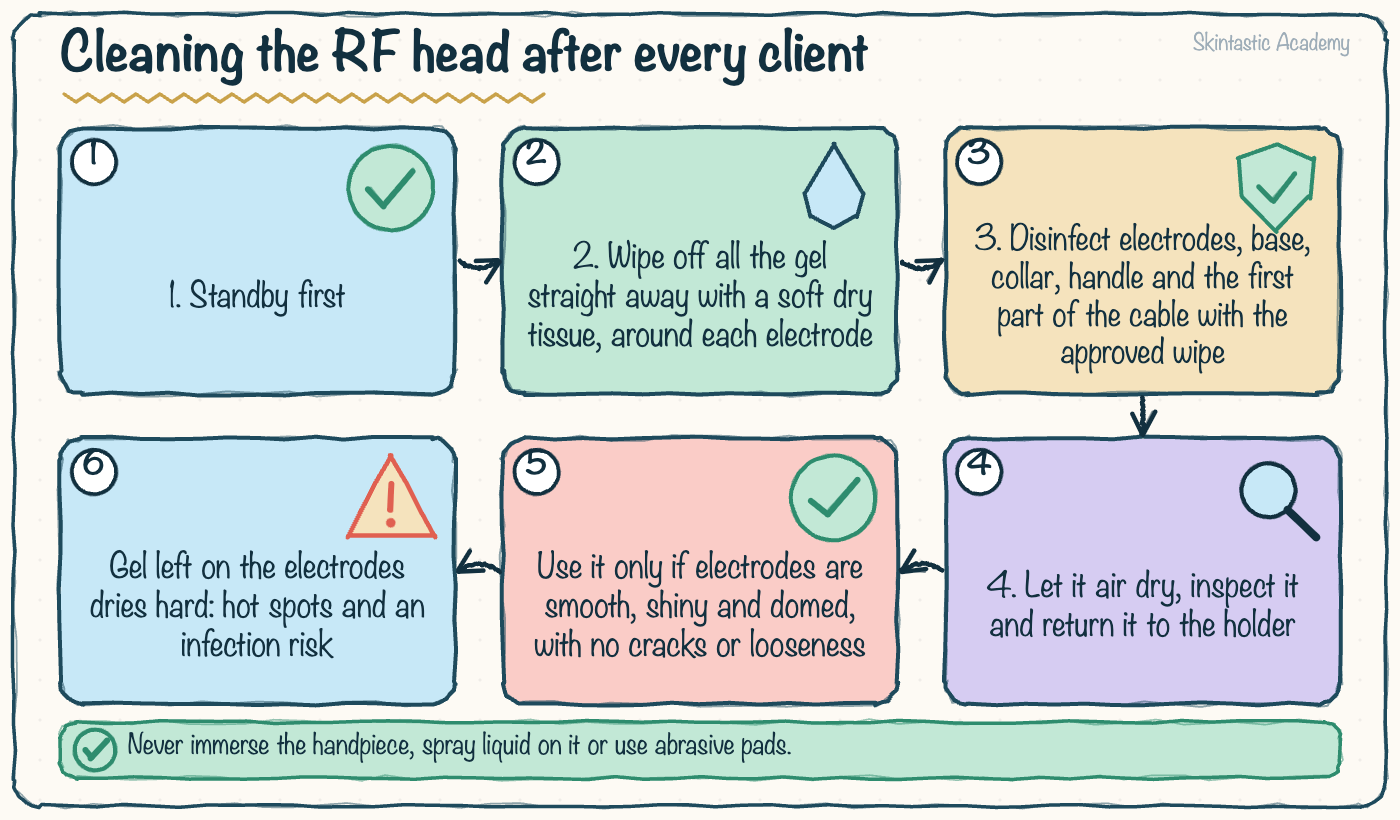
- Cleaning the RF head after every client
- Troubleshooting and keeping the logs
Lesson 6: Safety: electricity, burn prevention, the room, the law and infection control (7 topics)
- Electrical safety before every session
- The Laser Controlled Area and emergencies in the clinic
- Preventing burns: technique and the three rules
- Metal, implants and implanted electronic devices
- The treatment room, health and safety law and risk assessment
- Infection control: cleaning, hands, PPE and gel hygiene
- Waste, and managing it correctly
Lesson 7: Who and what it is suitable for: consultation, contraindications and consent (9 topics)
- The consultation: a structured clinical conversation
- Contraindications: who must not be treated
- The manufacturer's additions, and medicines that matter
- Wait, adjust or get written clearance
- Excluded areas, and treating the eye area with care
- Waiting times after other treatments
- Informed consent
- Photographs and the test patch
- Pre-treatment advice for clients
Lesson 8: Settings: what they do, where to start and how to find the right level (6 topics)
- What the three settings do
- The reference settings and your settings window
- The tolerance test, step by step
- The three endpoints: feel, look, measure
- Using the infrared thermometer
- Adjusting for area, skin type and later sessions, and recording settings
Lesson 9: Step-by-step treatment guide and treatment protocols (13 topics)
- The treatment session in 10 steps: preparing (steps 1 to 5)
- The treatment session in 10 steps: treating and finishing (steps 6 to 10)
- Technique essentials: holding, moving, lifting and supporting
- Judging the endpoint, guide times and keeping the gel topped up
- Protocol 1: the full face lift sequence
- Protocols 2 and 3: nasolabial folds and forehead
- Protocol 4: the eye area
- Protocol 5: jawline and neck
- Protocol 6: décolletage
- Protocol 7: abdomen
- Protocol 8: arms and thighs
- Common mistakes and how to put them right
- RF made simple: the quick guide
Lesson 10: Sessions, intervals, expectations and the clinical evidence (5 topics)
- How many sessions, and how often?
- What clients may notice, and when
- The clinical evidence in brief
- Named studies at a glance
- Using before and after photographs honestly
Lesson 11: Aftercare, side effects and complications (5 topics)
- What is normal after RF, and aftercare in the clinic
- Client aftercare advice: the leaflet
- Side effects that need action
- Burns: first aid and where to send the client
- Incidents, follow-up and working within your scope
Lesson 12: The law, insurance and professional practice (7 topics)
- Who regulates what, and licensing around the UK
- England and Scotland in more detail
- Health and safety at work, and electromagnetic fields
- Describing your device correctly, and incidents with the machine
- Insurance, consent and records
- Advertising, complaints and scope of practice
- Your compliance checklist
Lesson 13: Your final assessment (3 topics)
- How your final assessment works
- Revision map: what to be sure of before you sit it
- Answering the written parts and the scenario well
Lesson 14: Your practical day (4 topics)
- Your practical day: the programme and what to have ready
- What Carla observes, item by item
- Your model: screening, forms and the record set
- Your certificate and next steps
How you are assessed
Each teaching lesson ends with a short multiple choice quiz, marked automatically (pass mark 80%). The final assessment has three parts. Part A is 12 multiple choice questions, marked automatically (pass mark 80%). Part B is 12 written questions and Part C is a scenario answered in four written parts. Written answers are entered online and read with the help of an AI assistant, with feedback by email (pass mark 80% for each). Your practical skills are observed on your compulsory practical day: Carla observes every treatment you carry out and gives feedback as you work. Your certificate appears on your course page once you have completed the online theory. It becomes valid once Carla has observed every treatment you carry out on your practical day and confirms it.
A look inside the course
3 of the diagrams and pictures from the online lessons.
Frequently asked questions
Do I have to attend a practical day?
Yes. One compulsory full practical day at our Southampton academy is part of the course and is included in the price, because radio frequency treatment of live skin is learned face to face and cannot be done online. You will treat a minimum of three models, provided by Skintastic, and Carla observes every treatment you carry out. We arrange it with you by email after you buy. Your certificate appears on your course page once you have completed the online theory. It becomes valid once Carla has observed every treatment you carry out on your practical day and confirms it.
How much does the radio frequency skin tightening course cost?
The course costs £499. The price includes the online lessons, your hardback manual and workbook posted free of charge, and your compulsory practical day. Pay by card, Apple Pay, Google Pay or PayPal. Klarna and Clearpay may also be offered at checkout, subject to status.
Can I study at my own pace?
Yes. The online lessons let you work at your own pace and go over anything as many times as you need before your practical day. Your written work is completed online and read with the help of an AI assistant, with feedback by email. The practical day is a fixed date that we arrange with you by email after you buy.
What qualifications do I need before I buy?
You need a recognised qualification in Anatomy and Physiology at Level 3 or above, and you must be 18 or over. Because this is a radio frequency course and not a laser or light course, you do not need the Laser and IPL Core of Knowledge certificate. If you do not hold Level 3 Anatomy and Physiology, you can take it with us first. We accept Recognition of Prior Learning against the Anatomy and Physiology requirement if you send us your evidence before you buy. It is never accepted in place of the practical day.
Is the course accredited, and how do I check?
CPD accreditation for this course has been applied for and is not confirmed yet, so no CPD credits or activity number are shown. When The CPD Group approves it, we will show the credits and activity number on this page and on the course page, and you will be able to check them on The CPD Register. Skintastic Aesthetic Lasers Ltd is already an approved provider with The CPD Group, number 777800, which you can verify on The CPD Register. This is a CPD course, not a regulated qualification, and it carries no qualification level.
Will I get a certificate, and when?
Yes. Your certificate appears on your course page once you have completed the online theory. It becomes valid once Carla has observed every treatment you carry out on your practical day and confirms it. You also complete a full record set for each of your models and sign a student declaration. A certificate confirms that you completed the training. It is not a licence to practise and it is not confirmation that you are insured.
Will my insurer cover me?
We cannot promise that. Most insurers want to see an existing beauty or aesthetics qualification alongside a CPD certificate before they cover you for a treatment. Check with your insurer, and make sure the policy names radio frequency skin tightening and your device, before you treat paying clients. You should also check your local authority’s licensing requirements.
Who provides the models, and what should I wear?
Skintastic provides the models, and you treat a minimum of three. Lunch is provided on your practical day. Please wear salon clothes or smart casual, and remove rings, bracelets and watches before practical work. Bring your Anatomy and Physiology certificate, photographic identification and your manual.
Will I receive a printed manual?
Yes. A hardback manual and workbook is posted to every student free of charge, as your study text, including outside the UK. We post it to the billing address you enter at checkout, so please check it is the address where you want it sent. See our delivery page for the details.
How long do I have access to the online lessons?
Your access to the online lessons lasts 12 months from the date of purchase. When the 12 months end, your access ends, but your certificate and the manual we posted to you stay with you. We do not offer extensions or a pause of the 12 months.
Can I cancel and get a refund?
You have 14 days to cancel, but the right to cancel the online materials is lost once your access starts and you have ticked the box at checkout to agree to that. Once the 14 days have ended, courses are non refundable. Refunds that apply are paid to the original payment method within 14 days of us receiving your written cancellation. Full details are in our terms and conditions and our refund and cancellation policy.
More answers are on our frequently asked questions page, and our delivery page explains how your free hardback manual is posted.