
Learn to assess and plan laser removal of eyebrow, eyeliner, lip liner and scalp micropigmentation pigment safely and honestly. This advanced CPD course is written for qualified laser professionals who already treat tattoos and want the specialist judgement that facial and scalp pigment demands. It prepares you for your compulsory practical day with Carla in Southampton.
Accredited CPD course: 10 CPD credits
The CPD Group accredited activity #1018732. Skintastic Aesthetic Lasers Ltd is an approved CPD provider (#777800). This is a CPD course: it is not a regulated qualification and carries no qualification level.
Check this accreditation yourself on The CPD Register.
What this course covers
- UK regulation, licensing and health and safety for laser work
- How SPMU pigments differ from traditional tattoo ink, and why some darken under laser
- Patch testing and eyebrow removal
- Lip liner removal, and why lip blushing is not suitable for laser
- Eyeliner removal, including the prescribing and eye protection requirements
- Scalp micropigmentation removal
- Consultation, medical history, consent, aftercare and records
How it works
The course carries 10 CPD credits. You study the theory online at your own pace, answering the quizzes and written questions online. Multiple choice is marked automatically, and your written answers are read with the help of an AI assistant, with feedback by email. You then attend one compulsory full practical day, face to face at 26 The Avenue, Southampton, which is included in the price and arranged by email after you buy. Skintastic provides the models, you will treat a minimum of three models, and Carla observes every treatment you carry out. Which areas you treat depends on the models available on the day: eyeliner is treated on a live model where a suitable model is available, and otherwise it is demonstrated and explained. A hardback manual and workbook is posted to you free of charge when you buy. Results vary between clients and complete removal cannot be guaranteed, and the course teaches you to say so clearly. Entry requirements are listed under Who can take this course below.
Your certificate: Your certificate appears on your course page once you have completed the online theory. It becomes valid once Carla has observed you carry out every treatment on your practical day and confirms it.
Student support group
Studying with us? Join our student support group on Facebook for help, answers and updates from the academy. Join the student support group.
Course at a glance
| CPD credits | 10 |
|---|---|
| CPD Group activity number | #1018732 |
| Practical day | One compulsory full day, face to face in Southampton, included in the price; you will treat a minimum of three models |
| Lessons | 11 lessons, 66 topics |
| Certificate | Appears on the course page once the online theory is complete; valid once Carla has observed you and confirms it |
Who can take this course
A recognised Level 5 Laser Tattoo Removal Diploma and a recognised advanced skin science qualification. The registration form also asks you to confirm a valid Core of Knowledge (laser safety) certificate, current professional indemnity insurance and LPA-approved Local Rules at your premises.
What you will learn
- Summarise the current UK regulatory position for light-based aesthetic treatments
- Describe how the four nations differ
- Define SPMU and name the areas it is used on
- Explain why SPMU pigment needs different thinking from a traditional tattoo
- Justify patch testing before any SPMU removal
- List the risks a patch test helps you to mitigate
- Summarise the design and results of the clinic case series
- Explain why it is a useful but limited source of evidence
- Distinguish lip blushing from lip liner
- Explain why lip blushing is not suitable for laser removal
- Explain how the laser removes eyeliner pigment
- Explain why treatment is deliberately gradual
- Describe what SMP is and why clients seek removal
- State the practitioner requirements for SMP removal
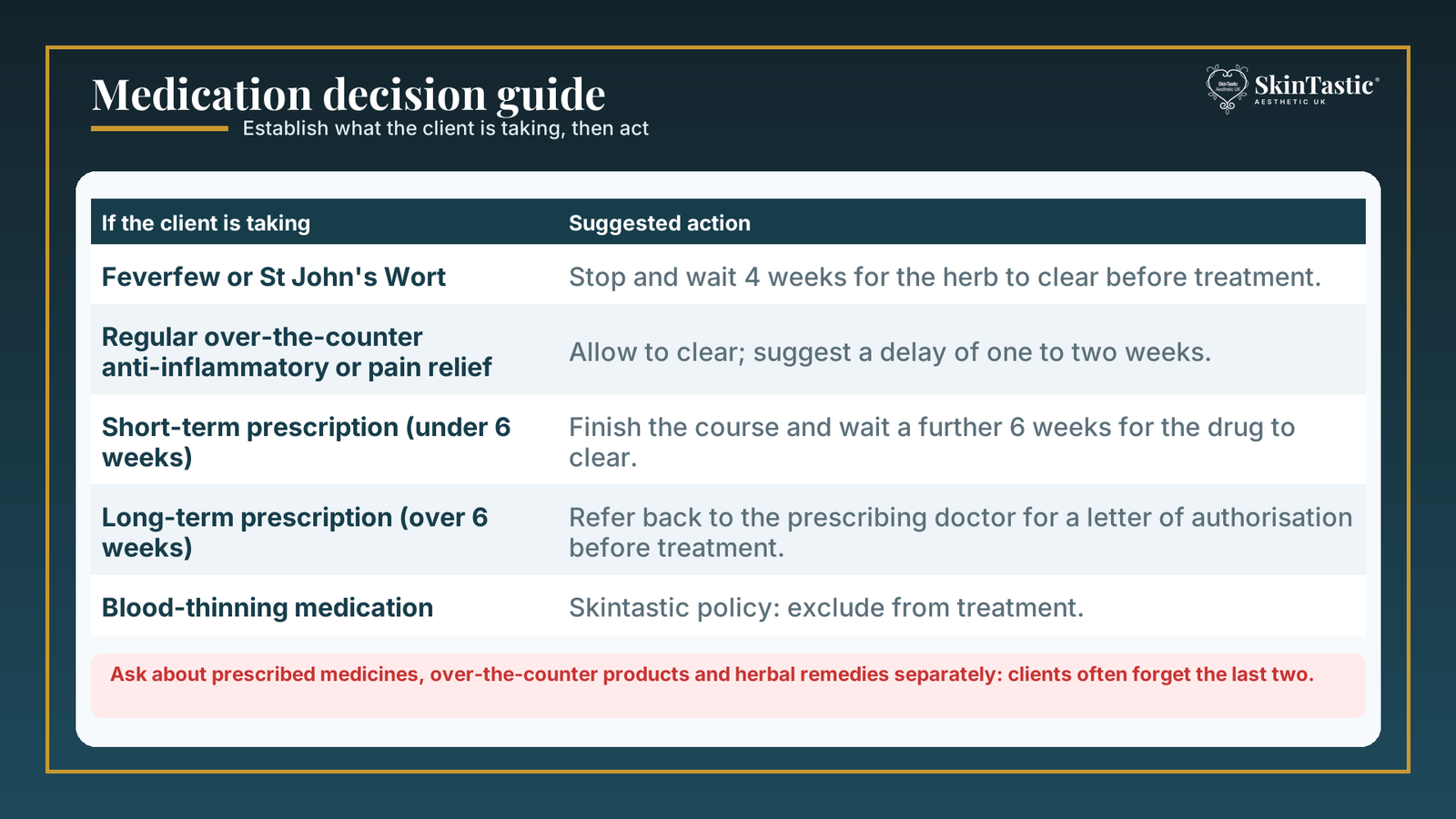
- Classify a client's medication into herbal, over-the-counter, short-term or long-term prescription
- Apply the suggested action for each category
Course structure
Lesson 1: Start here: your course guide (4 topics)
- What this course covers and who it is for
- Delivery, your practical day and CPD credits
- Learning outcomes and how they are assessed
- Your course leader, your responsibilities and how to get support
Lesson 2: Current regulations, safety standards and health and safety (7 topics)
- Who regulates what across the UK
- Local authority licensing in England
- The England-wide licensing scheme in development
- Health and safety law for laser work
- Minimum safety requirements and clinical governance
- The device, the UK Responsible Person and adverse incidents
- Clients, records, advertising and your compliance checklist
Lesson 3: Understanding SPMU pigments (7 topics)
- What SPMU is and how it differs from a traditional tattoo
- Organic and inorganic pigments
- Reading CI numbers and MSDS sheets
- Pigment identification: worked examples
- Hybrid pigments, implantation depth and layering
- Why some pigments darken: the chemistry
- Pigment-linked complications and the concluding principles
Lesson 4: Patch testing and eyebrow SPMU removal (7 topics)
- Why patch testing is essential
- The test-patch protocol and the 400 mJ training ceiling
- Waiting periods, patch-test sites and documentation
- Wavelength selection, brow hairs and the weave technique
- Eyebrow protocol part 1: preparation, eye protection and room safety
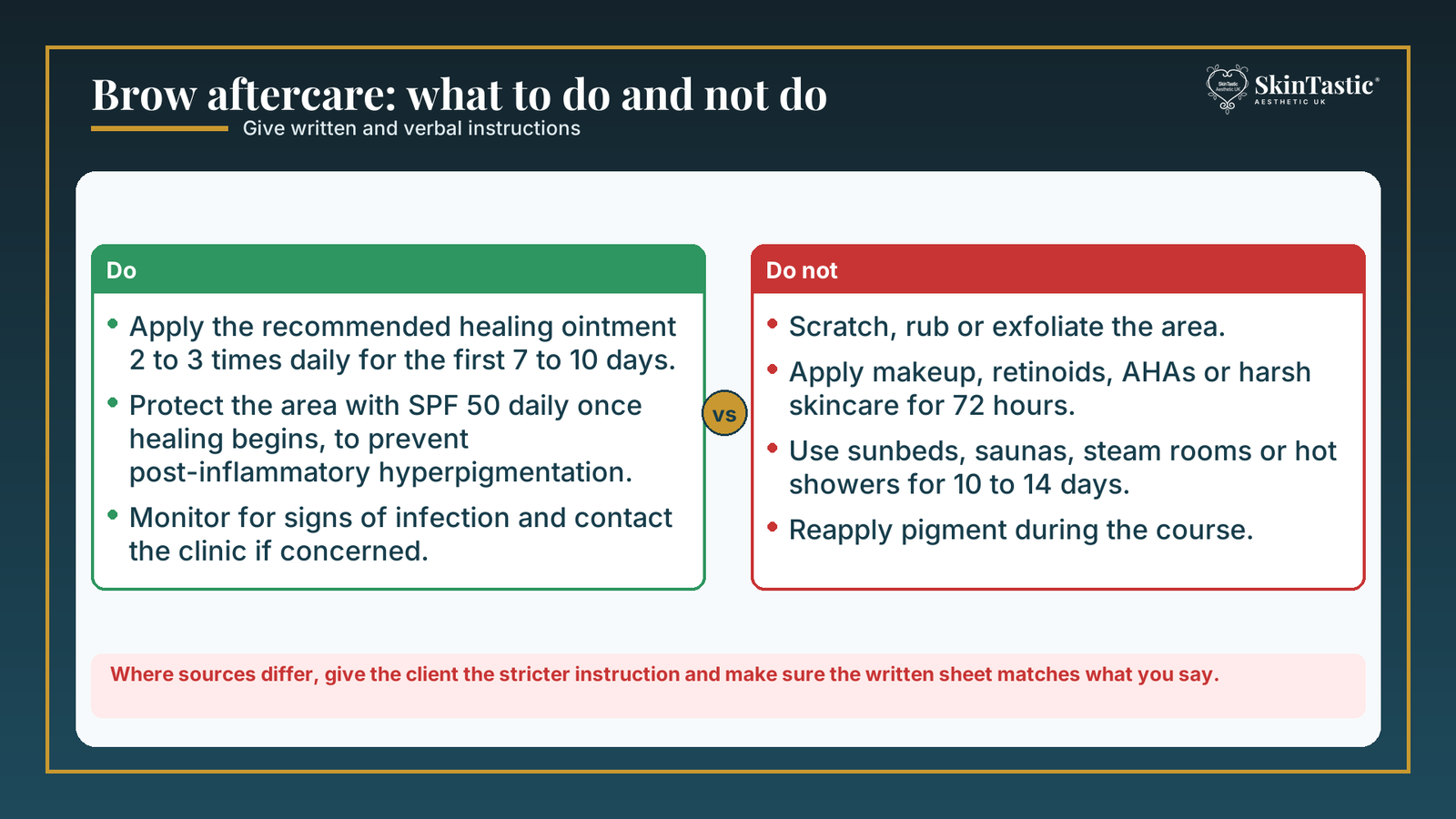
- Eyebrow protocol part 2: laser treatment, immediate care and aftercare
- Frequency, records and the practice doll patch-test activity
Lesson 5: Clinical evaluation and choosing a removal method (5 topics)
- A clinic case series: the Rummelein evaluation
- Pigment purity, labelling and what it means for you
- Clinical implications and the case review worksheet
- Laser removal and chemical removal compared
- Choosing the removal method
Lesson 6: Lip liner and lip tattoo removal (7 topics)
- Lip blushing and lip liner: which can be treated with laser
- Lip pigment risks and the darkening reaction
- Avoiding the darkening risk: assessment, testing and consent
- If darkening occurs: clinical management
- Lip-liner patch test, wavelength and contra-indications
- The full lip-liner session and the evidence
- Lip aftercare, interim makeup and professional competency
Lesson 7: Eyeliner tattoo removal (10 topics)
- How eyeliner removal works and why it is gradual
- Safety considerations: wavelength, controlled area and internal corneal shields
- Scope, prescribing and who carries out the eye steps
- Contra-indications and pre-treatment assessment for eyeliner
- Minims Tetracaine: prescription status and administration
- Tetracaine exclusion criteria
- Internal corneal shields: product information and insertion
- Full eyeliner removal workflow: governance to treatment
- Full eyeliner removal workflow: parameters, technique and darkening
- Eyeliner aftercare, review and records
Lesson 8: Scalp micropigmentation (SMP) removal (6 topics)
- Scalp micropigmentation: what it is and who may remove it
- SMP consultation and eligibility
- Patch testing the scalp
- Preparation, safety and parameters for SMP
- Full SMP treatment, zones, aftercare and the treatment course
- SMP risks, the evidence base and practice activities
Lesson 9: Consultation, forms and records (5 topics)
- Medication and the drugs decision guide
- The medical history and medication form
- Fitzpatrick skin typing
- The consent form and the model disclaimer
- Aftercare sheets, the LPA questionnaire and keeping records
Lesson 10: Your final assessment (3 topics)
- How the assessment works
- Your records and your practical day
- Revision guide: what to review before your assessment
Lesson 11: Your practical day (4 topics)
- What your practical day involves and how to prepare
- Practice doll and mannequin activities
- Live model treatment on your practical day
- Your certificate and next steps
How you are assessed
Each teaching lesson ends with a short multiple choice quiz, marked automatically (pass mark 80%). The final assessment has two parts. Part A is 33 multiple choice questions, marked automatically (pass mark 80%). Part B is seven written questions, answered online and read with the help of an AI assistant, with feedback by email (pass mark 80%). Your practical skills are observed on your compulsory practical day: Carla observes every treatment you carry out and gives feedback as you work. Your certificate appears on your course page once you have completed the online theory, and it becomes valid once Carla has observed every treatment on your practical day and confirms it.
A look inside the course
3 of the diagrams and pictures from the online lessons.
Frequently asked questions
Do I have to attend a practical day?
Yes. One full practical day at our Southampton academy is part of the course and is included in the price, because laser treatment of live skin is learned face to face and cannot be done online. You will treat a minimum of three live models on the day, provided by Skintastic. We arrange it with you by email after you buy. Your certificate appears on your course page once you have completed the online theory. It becomes valid once Carla has observed you carry out every treatment on your practical day and confirms it.
How much does the course cost?
The course costs £399. Pay by card, Apple Pay, Google Pay or PayPal. Klarna and Clearpay may also be offered at checkout, subject to status.
Can I study at my own pace?
Yes. The online lessons let you work at your own pace and go over anything as many times as you need before your practical day. Your written work is completed online and read with the help of an AI assistant, with feedback by email. The practical day is a fixed date that we arrange with you by email after you buy.
What qualifications do I need before I buy?
You need a recognised Level 5 Laser Tattoo Removal qualification, a recognised advanced skin science qualification and a current Core of Knowledge certificate. Your Level 5 qualification is above the minimum of a regulated Level 3 that every course requires. If you are missing the Core of Knowledge you can take it with us first.
Is the course accredited, and how do I check?
Yes. It is accredited by The CPD Group as activity #1018732 for 10 CPD credits, and anyone can check it on The CPD Register using the link in the accreditation section above. It is CPD, not a regulated qualification.
Will I get a certificate, and when?
Yes. Your certificate appears on your course page once you have completed the online theory. It becomes valid once Carla has observed you carry out every treatment on your practical day and confirms it. It shows 10 CPD credits, and you also receive a CPD reflective record for your portfolio.
Will my insurer cover me?
We cannot promise that. Your insurer must cover cosmetic tattoo removal including SMP, and eyeliner needs specific cover. Check with your insurer before you buy, or message us and we will help you check.
Who provides the models?
Skintastic provides the models, a minimum of three.
Will I receive a printed manual?
Yes. A hardback manual and workbook is posted to every student free of charge, as your study text. We post it to the address you enter at checkout.
How long do I have access to the online lessons?
Your access to the online lessons lasts 12 months from the date of purchase.
Can I cancel and get a refund?
You have 14 days to cancel, but the right to cancel the online materials is lost once your access starts and you have ticked the box at checkout to agree to that. Once the 14 days have ended, courses are non refundable. Refunds that apply are paid to the original payment method within 14 days of us receiving your written cancellation. Full details are in our terms and conditions.
More answers are on our frequently asked questions page, and our delivery page explains how your free hardback manual is posted.